 电话: +86 13342660375
  邮箱: contact@yizemould.com

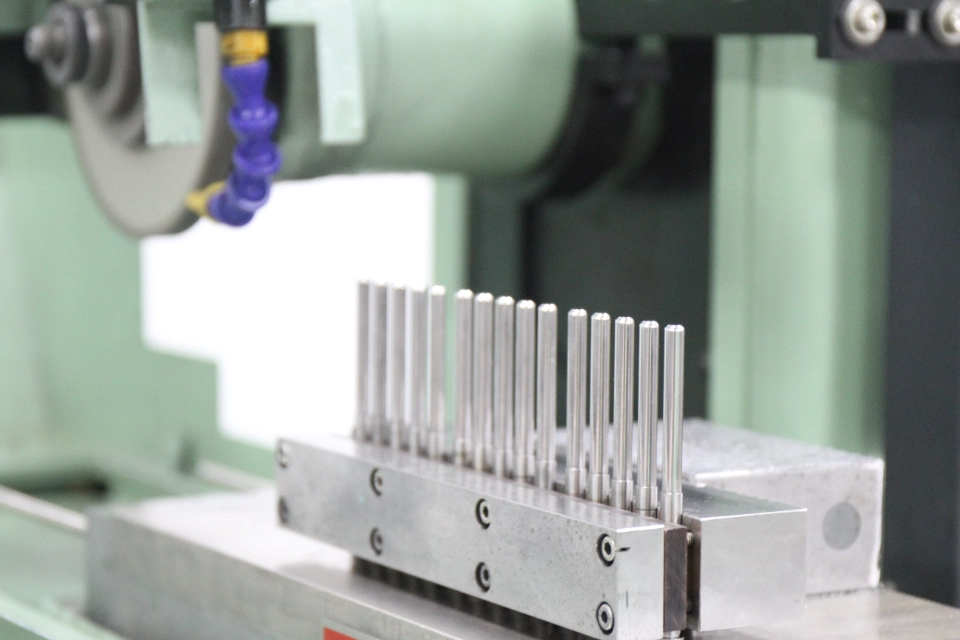


Our precision grinding workshop performs surface and end-face grinding for mold components, pins, inserts, plates, tooling parts, and cylindrical components requiring controlled length and consistent reference surfaces.
The image shows multiple slender cylindrical parts positioned vertically in a dedicated fixture while their upper end faces are ground to a uniform level. This setup is suitable for processing several components together when consistent height, flatness, and end-face quality are required.
Key Advantages:
- Consistent part height
- Accurate end-face control
- Stable flatness
- Multi-part processing
- Reliable datum preparation
磨削加工能力
平面磨削通过旋转砂轮从平坦表面受控去除一定量的材料,用于建立准确的基准平面,并改善零部件不同表面之间的尺寸关系。
对于垂直放置的销类和圆柱类零件,端面磨削可帮助控制:
- 零件总长度
- 端面平面度
- 两端平行度
- 端面对零件轴线的垂直度
- 同批次零件的高度一致性
- 定位面的表面质量
典型加工零部件包括:
- 模具销
- 顶针
- 型芯针
- 导向销
- 精密冲头
- 小型轴类零件
- 圆柱形镶件
- 工装及夹具零部件
专用夹具可在磨削过程中使工件保持稳定且有序排列。多个零件可作为一组进行检测和加工,有助于提高同一装配组件或同套模具零件之间的一致性和重复精度。
在制造流程中的作用
平面磨削和端面磨削可安排在车削、热处理、外圆磨削或粗加工之后进行。该工艺能够为后续装配、配模、测量或进一步机械加工提供准确的基准表面。
典型工艺流程包括:
- 初步机械加工
- 必要时进行热处理
- 外圆磨削
- 夹具定位
- 平面或端面磨削
- 高度及平面度检测
- 最终尺寸验证
将该工序保留在工厂内部,可使磨削团队直接协调零件长度、加工余量、夹具布置及检测要求,从而提高加工过程中的尺寸一致性,并缩短工艺调整和质量反馈路径。
联系信息
-
 地址
中国广东省东莞市长安镇沙头社区靖海东路62号
地址
中国广东省东莞市长安镇沙头社区靖海东路62号


 预约上门服务
给我们留言
如有疑问或需要帮助,请联系我们,我们将很乐意为您提供协助!


